Conflict Transformation in Balochistan: Considering Agonistic Dialogue for Ending Violent Conflict
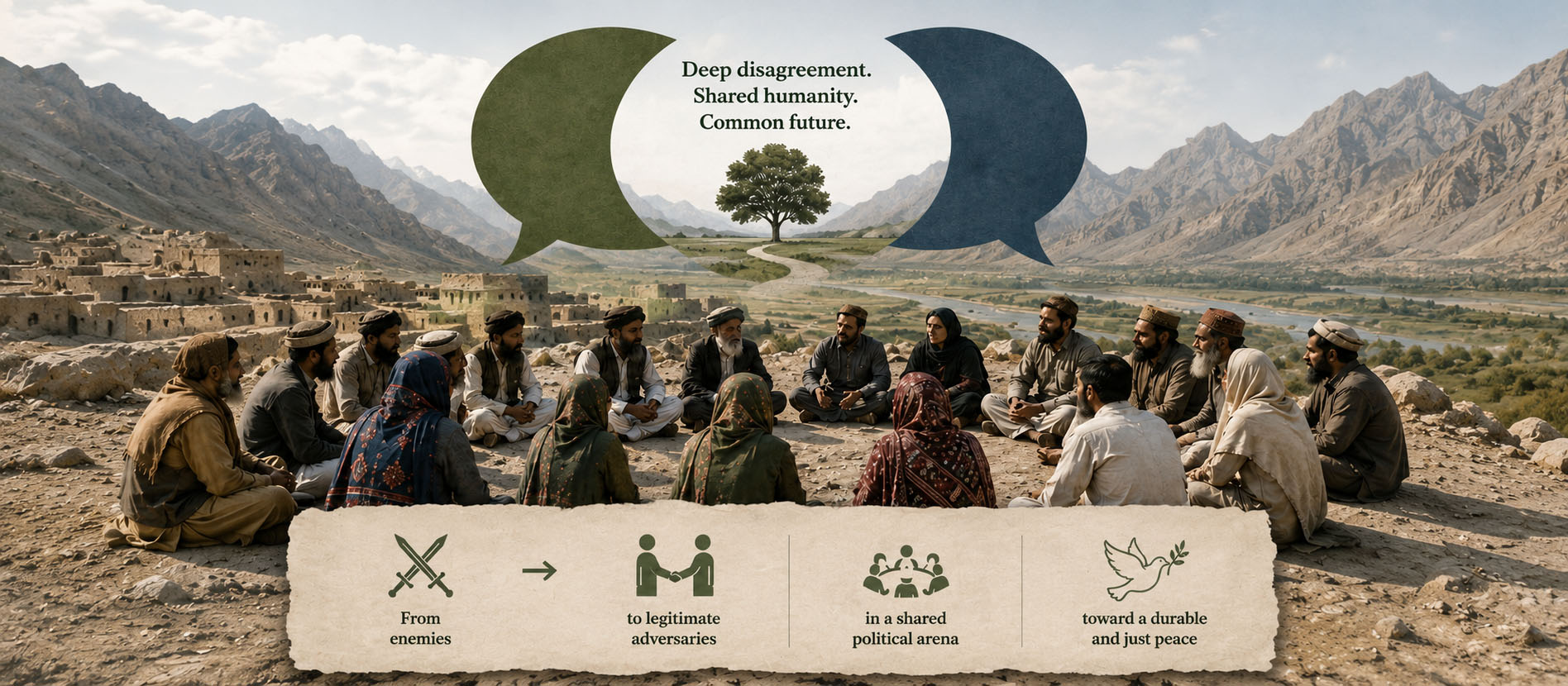
The conflict in Balochistan has resisted decades of military and political solutions. This article asks whether a different posture toward disagreement, one that treats adversaries as legitimate opponents rather than enemies to be eliminated, can open a durable path out of violence.
The Problem
Balochistan's conflict is among the most protracted in South Asia. Successive attempts to resolve it have leaned on force or on top-down political settlements that treat the province's grievances as problems to be managed rather than relationships to be repaired. The result has been cycles of violence in which each side hardens its position and the space for genuine political contest disappears.
This article argues that the failure is not only strategic but conceptual. When a state and a movement each see the other as an enemy to be defeated, the only available outcomes are victory or annihilation. What is missing is a framework that keeps deep disagreement alive without turning it into deadly antagonism.
Agonistic Dialogue
Drawing on the political theory of agonism, the article considers dialogue not as a search for consensus that erases difference, but as a way of transforming enemies into legitimate adversaries. In this view, conflict itself is not the problem; the problem is the form conflict takes. Agonistic dialogue channels contestation into a shared political arena where opponents recognize one another's right to make claims, even as they continue to disagree.
Applied to Balochistan, this reframing shifts the goal from ending disagreement to changing its character, from a fight over whether the other side may exist to a contest over how competing claims are heard, negotiated, and lived with over time.
Toward Transformation
Conflict transformation, unlike conflict resolution, does not promise a tidy settlement. It works patiently on the relational, structural, and cultural conditions that reproduce violence. The article suggests that agonistic dialogue offers a realistic first move: it does not require the parties to trust or agree, only to grant each other standing as legitimate participants in a continuing political conversation.
That modest shift, the article contends, is what makes sustained peacebuilding in Balochistan imaginable. It reframes an intractable war as a political relationship that can, with time and honest engagement, be transformed.
Ullah, Rehmat, and Mavara Inayat. “Conflict Transformation in Balochistan: Considering Agonistic Dialogue for Ending Violent Conflict.” Pakistan Journal of Humanities and Social Sciences, vol. 11, no. 3, 2023, pp. 3723–3731. DOI: 10.52131/pjhss.2023.1103.0651
Read the full article →